
Home/Pool, Patio & Deck Lighting
Pool, Patio and Deck Lighting
People spend serious money building rooms outside and then stop using them at sunset. Lighting a pool deck or a patio well is mostly a question of keeping every source out of the places you actually look.
Still water is a mirror, and it is aimed at you
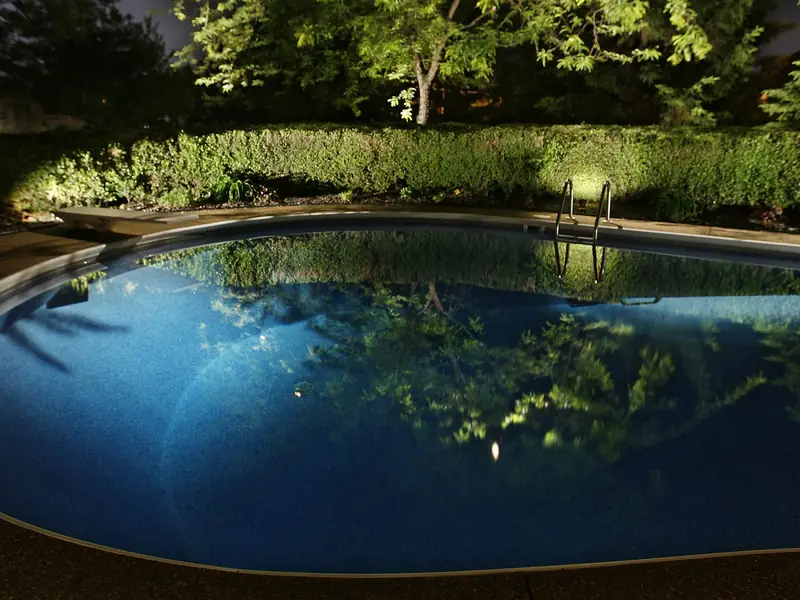
This is the thing that makes pool lighting different from everything else on a property. A pool at night is a horizontal mirror, and anything bright near its edge appears twice: once as the fixture and once as a hard reflection sitting on the surface.
It is why so many expensive pool decks are uncomfortable after dark. Nothing is technically wrong; there is simply a row of small suns lying on the water wherever you sit.
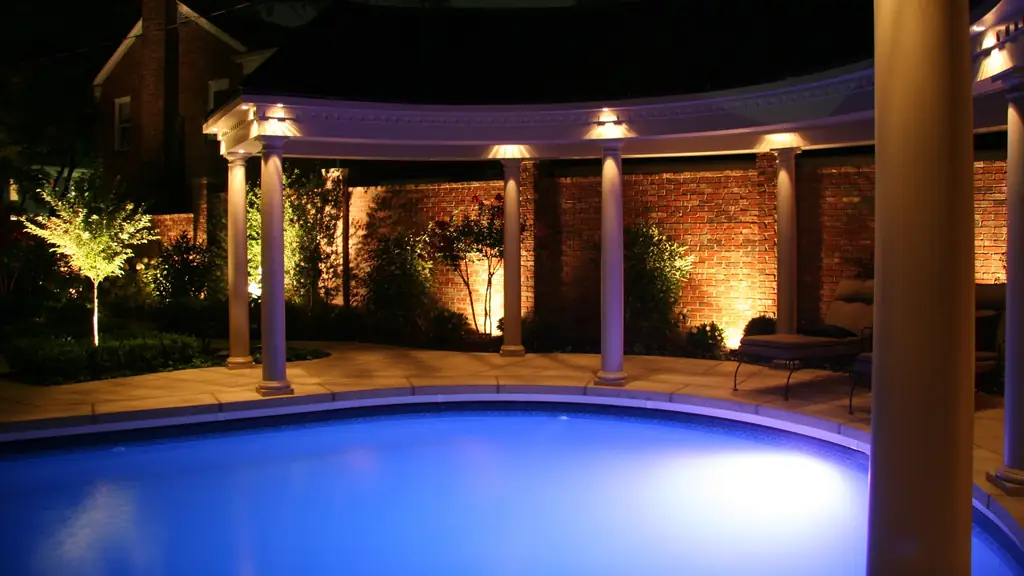
The answer is to move the light up and back. Fixtures in the surrounding trees, under the eaves of the house, in a pergola or a pool house, and in the structures around the deck rather than at its edge. Light arrives from above at a steep angle, the surface stays dark and reflective in the way water should be, and what you see in it is the lit trees and the lit house.
What still gets lit at ground level
Some things genuinely need light where they are, and those are the ones where a fall happens:
- Steps and level changes. Every riser between the house and the water, lit from the side or from beneath the nosing so the tread edge reads clearly.
- Coping. The pool edge itself has to be unmistakable from every approach, particularly where the deck material and the coping are similar in tone.
- Rails and grab bars. Lit from beneath, which also makes the ironwork itself worth looking at.
- Changes in surface. Where stone meets grass, or a deck meets a path.
All of these are low output and shielded. You should be able to see the edge without ever seeing the thing that showed it to you.
Decks, pergolas and covered structures
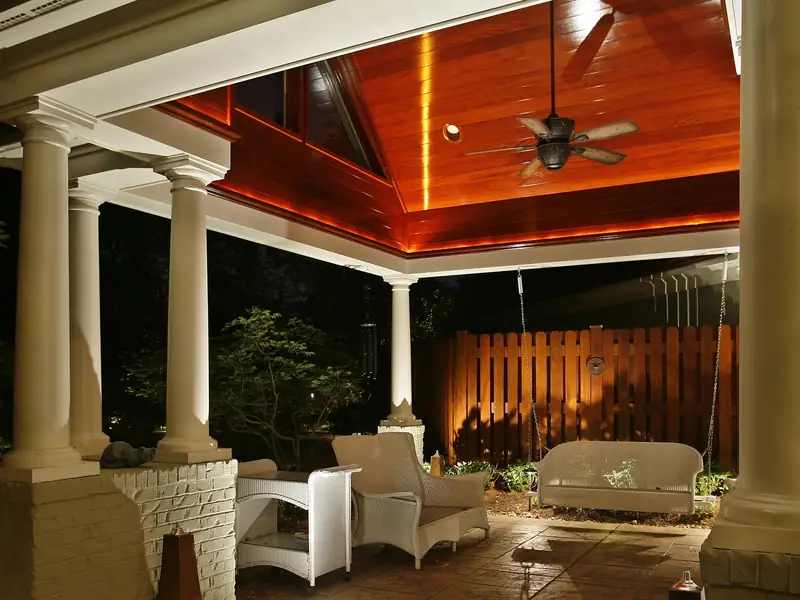
A roof over an outdoor room is an opportunity, because it gives you a ceiling to light from. Fixtures set into a pergola's beams or a porch soffit put light down onto the table and the floor and leave the sight lines clear, which is exactly how you would light the same room indoors.
Wooden decks take small fixtures into the rail posts and beneath the stair nosings. On a deck that stands well above grade, lighting the ground underneath it is worth doing too, because it removes the black void the deck otherwise sits on and makes the whole structure feel anchored.
Water features are their own problem
A fountain, a waterfall or a spillway behaves nothing like a pool, because the water is moving. Moving water scatters light instead of reflecting it, so a fixture placed within or beneath the flow makes the water itself glow.
Getting that right is a matter of where in the flow the fixture sits and how the beam meets the falling water; a few inches changes it completely. It is one of the more enjoyable things we do, and there are several examples in the gallery.
Electrical and code
Low-voltage work near a pool has clearance rules about how close a fixture and a cable may come to the water, and those are not negotiable. Routing gets planned on the drawing against the deck construction rather than worked out on the day.
Underwater lighting inside the pool shell is a different trade, installed by the pool builder. We light everything around the water and will coordinate with whoever handles what is in it.
Around water
- Main light source
- Above and set back
- At deck level
- Steps, coping, rails
- Still water
- Reflect, do not light
- Moving water
- Light from within
- Inside the shell
- Your pool builder
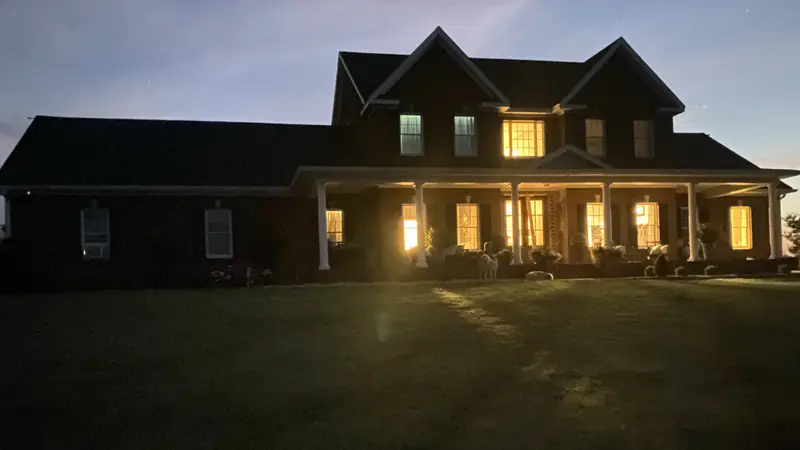
A covered porch, before and after.
A porch ceiling is a good place to hide a downlight. Drag the line to see this one before and after.
Questions about pools and patios
Yes. Most of the pool work we do is on finished decks.
Cable is run underneath hardscape rather than across it, and because the majority of the light comes from the structures and trees around the deck rather than from the deck itself, there is usually less to disturb than people assume.
That is almost always glare rather than quantity.
If fixtures sit at the water's edge or at eye height around the deck, your pupils never adapt and everything beyond the lit area reads as black. Moving the sources up and shielding them usually makes a deck feel brighter while measuring dimmer.
Yes, and task areas get their own treatment.
Cooking and food preparation need genuinely usable light on the surface, which means a small dedicated fixture overhead rather than raising the level across the whole space. The rest of the room stays at conversation level.
The equipment we specify is chosen for it.
Pool chemistry is hard on metal and a salt system harder still, which is one of several reasons we do not buy fixtures that are available at retail. What we install comes from manufacturers who sell only to professional lighting companies and who warrant the product.
Let's look at your property after dark
A designer comes out, walks the property with you and gives budget numbers by area. That visit carries no charge. If you want the drawing, we quote a design fee from there.
NiteLiters Inc. · 729 Cumberland St, Owensboro, KY 42303
Monday to Friday, 8:00am to 5:00pm