
Home/Architectural & Facade Lighting
Architectural and Facade Lighting
A building already has a geometry. Facade lighting either finds it or flattens it, and the difference is almost entirely in where the fixture sits relative to the surface, not in how much light comes out of it.
Grazing and washing are two different jobs
Put a fixture tight against a wall, aimed almost straight up the face of it, and the light travels across the surface at a shallow angle. Every projection casts a small shadow. On rough limestone, tumbled brick or a stone chimney this is transformative: you suddenly see the coursing, the tooling, the irregularity of the hand that laid it. That is grazing.
Pull the same fixture back several feet and aim it up at a steeper angle and the light lands evenly. Shadows disappear and the wall reads as one calm plane. That is washing, and on smooth stucco, painted siding or fine-jointed brick it is the right answer, because grazing a smooth surface only reveals that the surface is smooth.
Getting this backwards is the most common fault we find on facades lit by somebody else. Grazed stucco looks patchy and cheap. Washed fieldstone looks like a flat photograph of fieldstone.
Rooflines, gables and the glare problem
Uplighting a two-storey elevation from the ground is where most schemes go wrong. Aim high enough to reach the gable and the beam continues past it into the night sky, and anyone standing in the drive is looking straight into a bright source.
The fixes are shielding, beam-spread selection and, more often than people expect, putting the fixture somewhere other than the ground. A tight-beam fixture set into a soffit, or mounted in a tree opposite the elevation, lights a gable from above and keeps the source out of every sight line on the property.
Columns, arches and repeated elements
A colonnade or an arcade has rhythm built into it, and lighting can either keep that rhythm or destroy it. One fixture per column, matched in output and aim, reads as architecture. A general flood across the whole run reads as a car park.
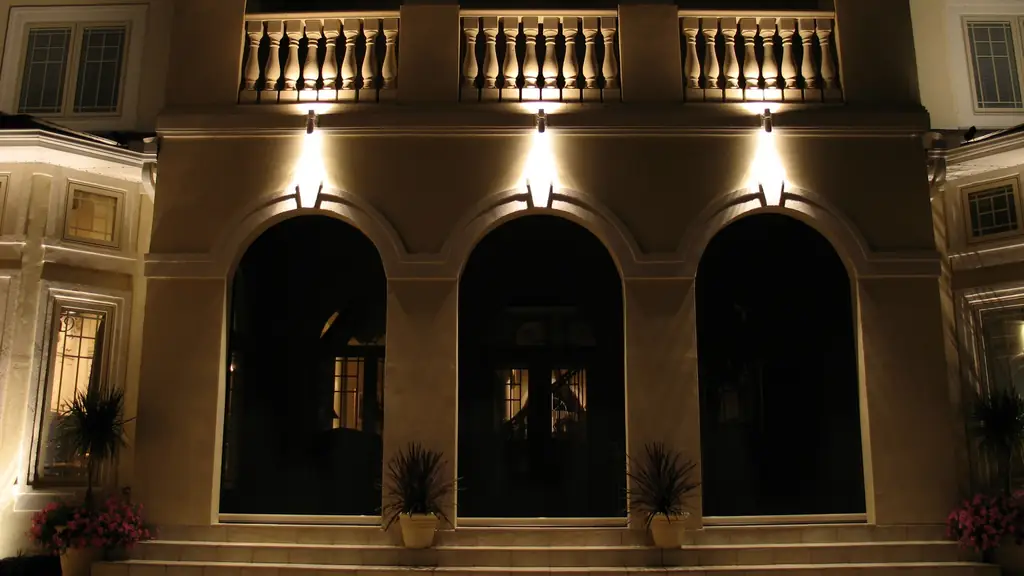
Arches are lit from directly above the opening so the curve carries the light around and the reveal holds its depth. The hero photograph at the top of this page is one fixture per arch, every one of them tucked where you would have to be looking for it.
Colour temperature changes the material
Kelvin is not a brightness setting, it is the colour of the light, and it interacts with the colour of the thing you point it at.
Warm light, around 2700K, flatters brick, limestone, cedar, copper and anything with red or yellow in it. Push a cooler lamp at warm brick and the brick goes grey and dead. Cooler light, nearer 3000K and above, keeps grey stone, blue-grey siding and green foliage looking like themselves rather than jaundiced.
Most homes need more than one temperature. A house of warm brick with a slate roof and mature green planting wants one answer on the walls and a different one in the trees, and the specification sheet on your drawing records which lamp goes where so a technician six years from now replaces like with like.
Where this work goes
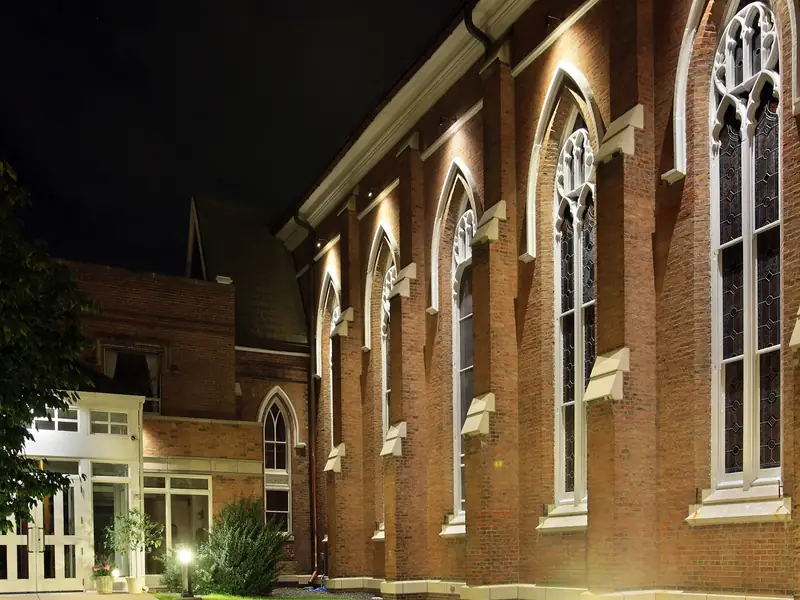
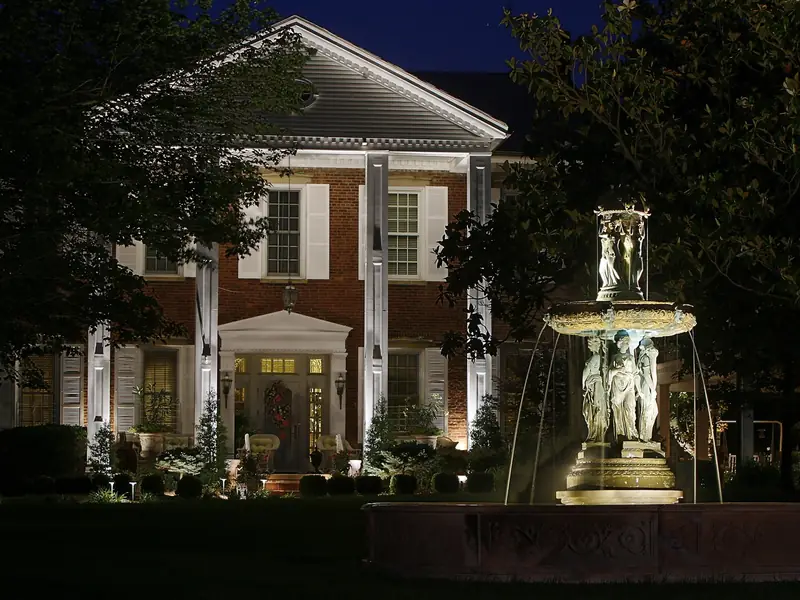
Facade lighting is the core of what we do on residential properties, and it is also most of our commercial work: church elevations, civic buildings, monuments and stone memorials. The technique does not change with the scale. Henderson's Italianate and Victorian brick, Jasper's Romanesque masonry and a 1990s Owensboro stone-and-siding elevation are each solved with the same set of decisions, made differently.
Rule of thumb
- Rough stone, old brick
- Graze
- Stucco, smooth siding
- Wash
- Warm brick and wood
- 2700K
- Grey stone, foliage
- 3000K+
- Gables
- Light from above
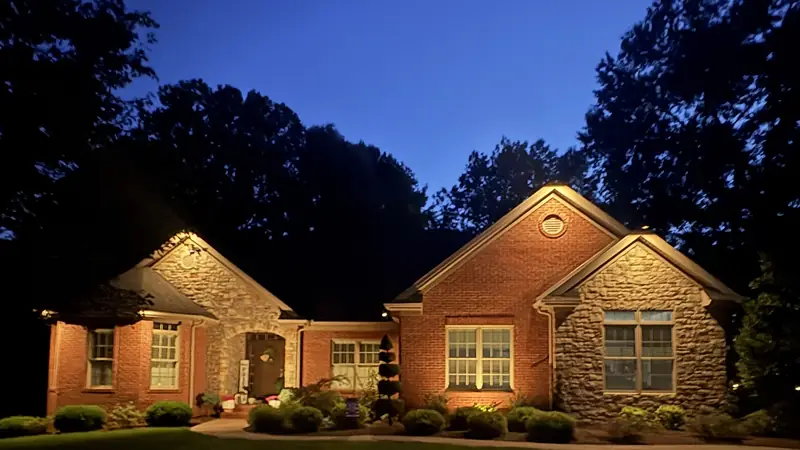
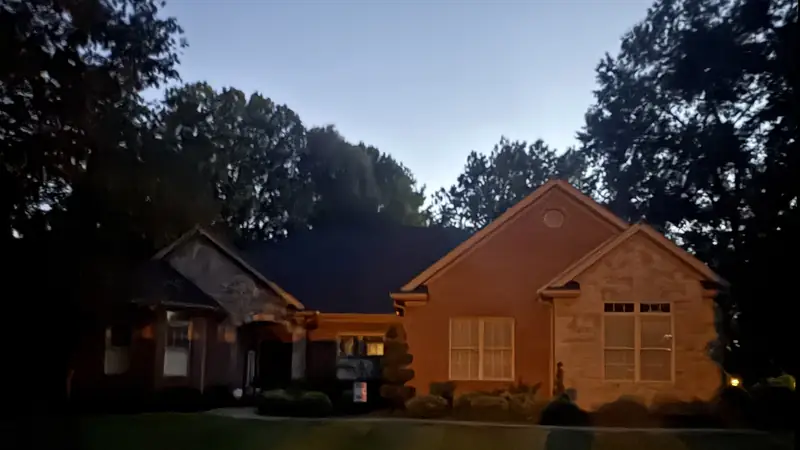
Grazing, before and after.
Stone gables lit from fixtures set close in at the base, so every course of stone shows. Drag the line to compare.
Questions about lighting a building
Not if it is designed rather than flooded.
A good facade scheme uses more fixtures at lower output than people expect, so the light is even and no single source is bright enough to be uncomfortable. Blasting an elevation with three big floodlights is the cheap way, and it is why so many lit houses look like storage yards.
Usually, and on older masonry that is the assumption we start from.
Cable runs in the mortar joint rather than through the brick, and is re-tuckpointed over. Where a fixture has to attach we look first at soffits, trim and existing penetrations. On a listed or district property we will work to whatever the local rules require.
On commercial and civic work, yes, where there is a reason for it.
Sculpture and seasonal display are the honest cases. On a house it almost always reads as a novelty within a season or two, and we will say so before you spend money on it.
They should not be, and part of the design process is standing in places that are not your property.
Shielding, beam spread and aim are chosen so light lands on your building and stops there. Spill into a neighbour's bedroom window is a design failure, not an unavoidable side effect.
Let's look at your property after dark
A designer comes out, walks the property with you and gives budget numbers by area. That visit carries no charge. If you want the drawing, we quote a design fee from there.
NiteLiters Inc. · 729 Cumberland St, Owensboro, KY 42303
Monday to Friday, 8:00am to 5:00pm