
Home/Outdoor Lighting Installation
Outdoor Lighting Installation in Owensboro, KY
Installation is where a low-voltage lighting design either disappears into the property or announces itself. Cable gets buried, run under drives and threaded through mortar joints, because the only thing you should be able to find at noon is the light itself.
Roughly three quarters of it goes on the building
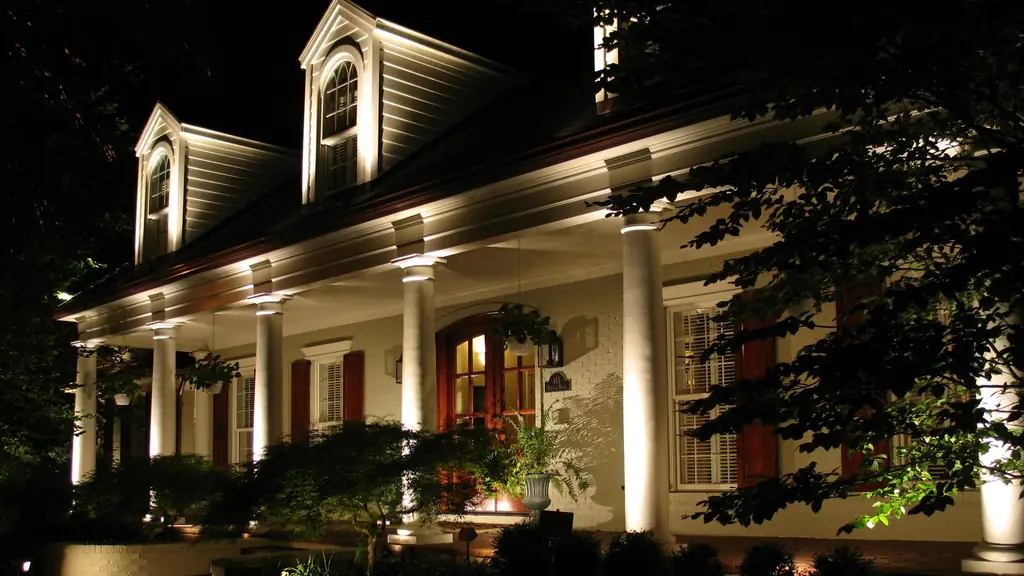
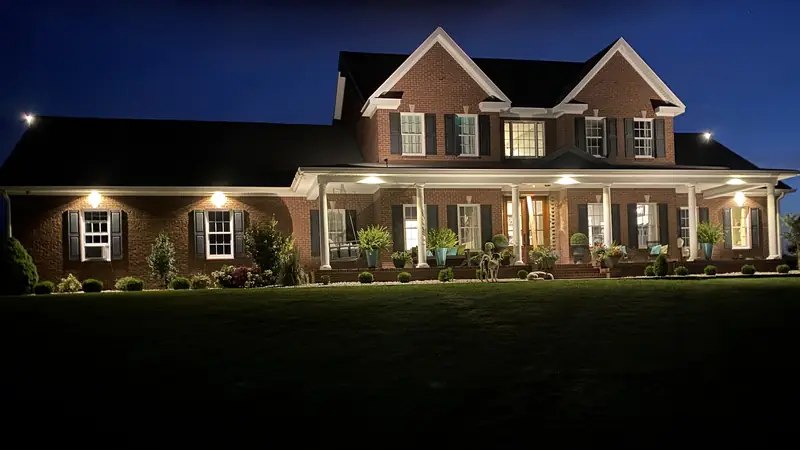
The lighting most people picture is a row of path lights pushed into the mulch. We use path lights where they genuinely belong, which is not very often. On a typical NiteLiters job around three quarters of the fixtures are mounted on the structure itself: under eaves, in soffits, against columns, up in gables, high in trees.
There is a straightforward reason more companies do not work this way. A fixture on the house needs cable that gets to the house and then climbs it without showing. That is slow, skilled work, and it is far easier to set a stake in a flowerbed and move on.
Getting cable across a property
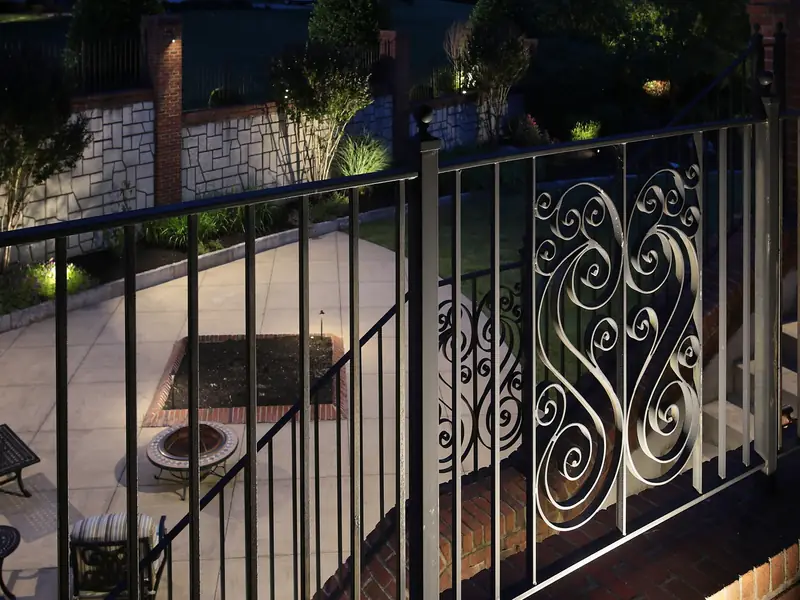
Cable is buried across lawn and bed. Under a driveway, a sidewalk or a patio it goes underneath rather than across, so the finished surface stays as it was before we arrived. Gary's own summary: we run it under driveways, under sidewalks, and around your pool.
Around a pool the routing is dictated by code and by the deck construction, and it is planned on the drawing rather than improvised on the day.
Climbing a wall without showing a wire
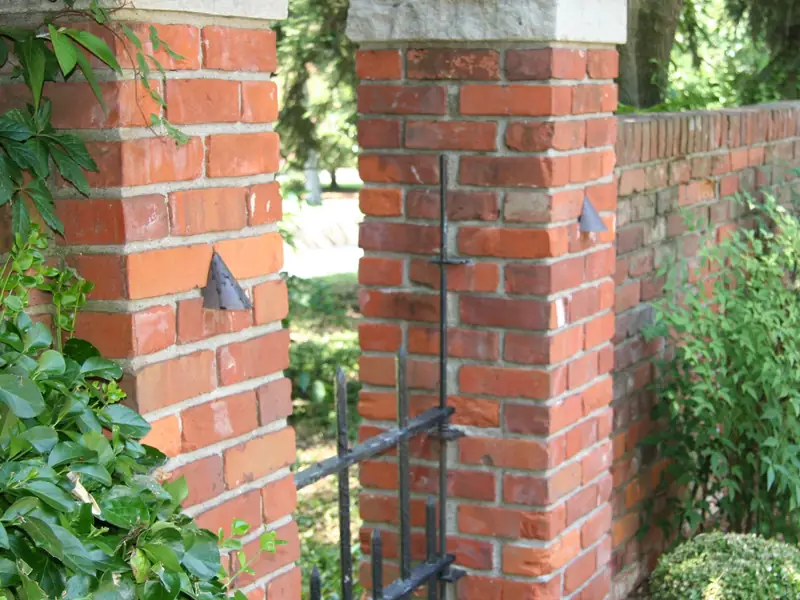
On brick and stone we grout out a mortar joint, lay the cable into the channel, and re-tuckpoint over it with mortar matched to what is already there. Done properly you can stand two feet away and not find the run.
This is the part of the trade we are quietly proudest of. Our camouflaging photographs are all shot in daylight, because daylight is the only condition under which the work is difficult.
Transformers and the maths behind them
Every fixture runs at twelve volts, stepped down from household current by a transformer mounted somewhere unobtrusive. Transformers are sized to the load on the drawing with headroom left for the zones you have not built yet, so adding the back garden in three years does not mean replacing the hardware you already bought.
Cable gauge is chosen run by run against the fixture count and the distance, so that the last lamp on a long run sees close to the same voltage as the first. Skip that calculation and the far end of the property burns dim, shifts colour and fails early.
The Reveal
Here is the part of the job nobody else in this region does the way we do.
Through the whole installation, you never see the system lit. We work in daylight, and when the last fixture is set we leave. Then we come back after dark, with the production crew held over into the evening, and we switch your property on for the first time while you are standing there.
We are usually about ninety-five percent right when our crew leaves. A downlight on the roofline is a degree off, a tree has grown since the design, one beam is a touch wide. Those get corrected that night, on ladders, while you watch. That is why our crew is there.
Afterwards you are handed a folder: the workmanship warranty, the manufacturer warranties on every product in the ground, and your service agreement. The balance of the invoice is collected then, and not before.
What payment looks like
Half at signing, half the night of the Reveal. On new construction, where the house may be six months from finished, we usually split it three ways instead: a third to reserve the schedule, a third at the start of the work, a third at completion.
We take credit cards. We do not offer financing.
On site
- Under drives
- Run underneath
- On masonry
- Mortar joint, re-tucked
- Fixtures on structure
- About 75%
- First lit
- At the Reveal
- Balance due
- That night
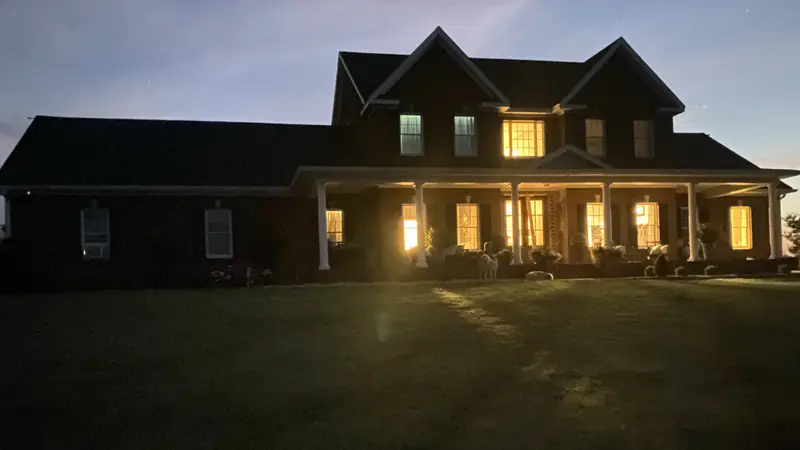
The house, lights off and lights on.
Fixtures in the porch ceiling and under the eaves, and low lights in the beds. Drag the line across the photograph.
Questions about the install
Most single-zone jobs are a day or two; a whole property with trees and a pool can run most of a week.
The drawing tells us before we start, so you get a real date rather than an estimate that slides. Getting cable under hardscape and the masonry work are the two things that take longest.
Cable trenching is narrow and closes back over itself, and within a few weeks you will not be able to see where it ran.
Cable goes under hardscape rather than through it. Mature planting is worked around by hand, because the reason many of these fixtures exist is the planting.
Within reason, yes, and that is largely what the evening is for.
Aiming, beam spread and lamp brightness are all adjustable on the spot, and our crew is there with ladders precisely so they can be. Moving a fixture to a different part of the property is a change to the design rather than an adjustment, and we would price that separately.
We come back twice, at ninety days and again at a hundred and eighty, and both visits are already paid for.
A technician checks every fixture, re-aims anything that has drifted and replaces any lamp that failed early. You receive an invoice showing what the visit would have cost, credited to zero, so you can see what you are getting.
The next part of the job
Let's look at your property after dark
A designer comes out, walks the property with you and gives budget numbers by area. That visit carries no charge. If you want the drawing, we quote a design fee from there.
NiteLiters Inc. · 729 Cumberland St, Owensboro, KY 42303
Monday to Friday, 8:00am to 5:00pm