
Home/Landscape Lighting Repair
Landscape Lighting Repair
A run that went dark, a transformer that stopped clicking on, water in a socket, a spade through a cable. We run around 110 service visits in a typical month, and repair work is a large part of what we do.
Why half your lights go out at once
This is the call we take most often, and it almost always surprises people: a dozen fixtures stop working and the owner assumes a dozen things broke. Nearly always it is one thing.
Low-voltage fixtures share a cable. Everything downstream of a fault goes dark with it, so a single cut, a corroded connection or a failed transformer takes out an entire side of a property. Finding the one fault is the whole job, and it is why a repair visit is diagnostic work rather than parts-swapping.
What actually fails
- Cable damage. By a wide margin the leading cause. A landscaper's spade, a fence post, an aerator, a contractor digging for something unrelated.
- Water in a connection. Anything below grade that was not sealed properly will eventually find moisture, and this region gives it plenty of chances.
- Transformer failure. Either the unit itself or, more often, the timer or photocell that decides when it comes on.
- Lamp end-of-life. Normal. Lamps we supplied carry a five-year warranty and we replace them at no charge inside it.
- Corroded fixtures. Usually the point at which a big-box fixture has told you what it was worth.
- Growth. Not a fault at all. A shrub has grown into the beam, or a tree has moved a downlight ten degrees off where it was aimed.
If another company put it in
Call the office and ask. We will tell you honestly whether it is something we can take on, and we would rather say no on the phone than take your money and disappoint you. Where we do take it, a technician traces the runs, locates the transformers, tests the voltage at each point and works out what is actually in the ground, which is often not what the owner was told when it went in.
Then you get a straight answer in one of three shapes. Either it is a repair worth making, or it is a system that can be brought back but needs several components replaced, or it has reached the end of its life and further money spent on it is money wasted. We would rather say the third thing out loud than keep coming back every spring to revive fixtures that were never built to last.
The equipment question
The fixtures and equipment we install are not sold at a local hardware store or a big-box retailer. They are made available only to professional lighting companies, and the manufacturers stand behind them with warranties that we service ourselves.
That matters because it is the difference between a repair that holds and one you pay for again next spring. Where equipment has simply reached the end of its life we will say so plainly rather than keep charging to revive it.
How a service call runs
Call the office at (270) 685-7070 and describe what is happening. Which fixtures, when it started, whether anyone has done work on the property recently. That last question solves a surprising number of cases before anyone gets in a truck.
A technician comes out, diagnoses on site and carries the common failure parts. Most repairs are finished in the same visit. If a part has to be ordered, we tell you what it is and what it costs before ordering it.
When the repair is done we will usually suggest a maintenance plan, because most of what we are called out for is something a scheduled visit would have caught first.
Service
- Visits per month
- Around 110
- Other companies' systems
- Call and ask
- Lamp warranty
- 5 years
- Office hours
- Mon to Fri, 8 to 5
- Emergency call-out
- Not offered
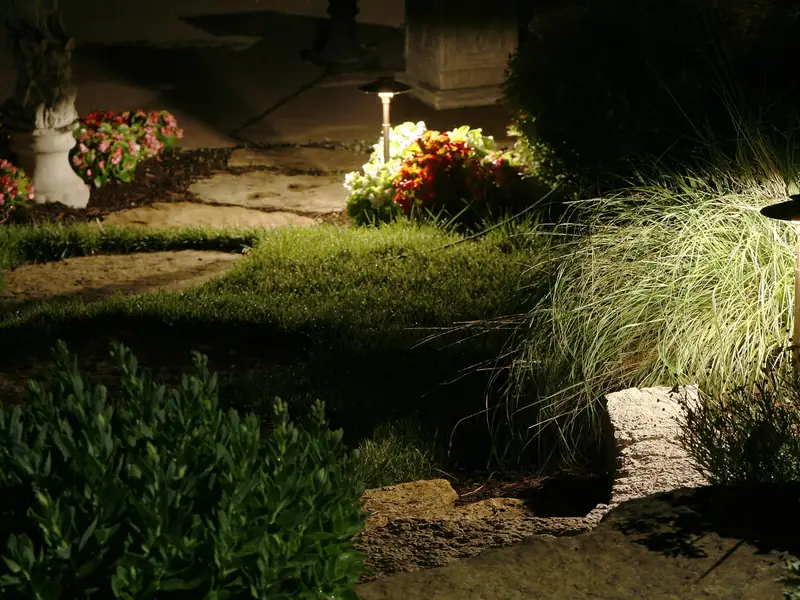
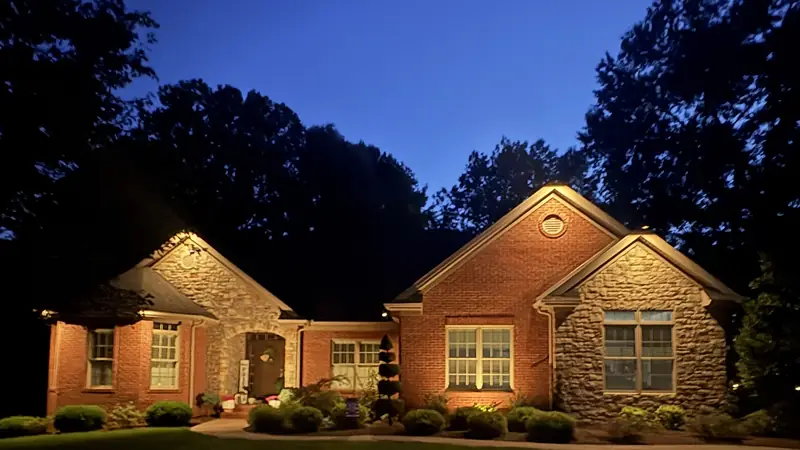
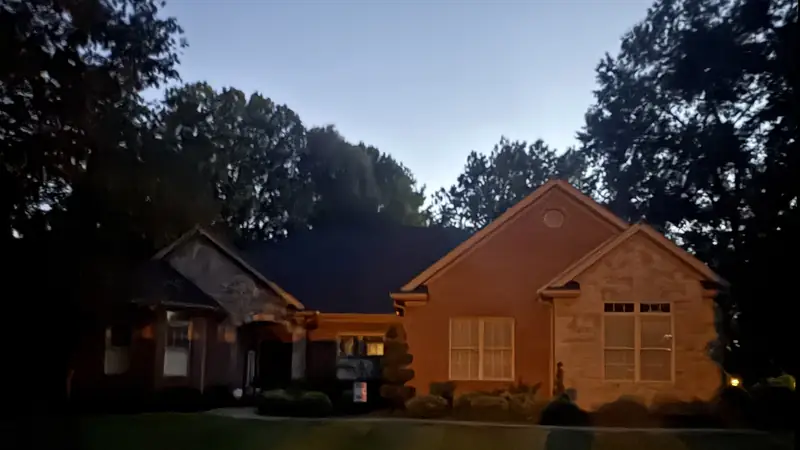
What it looks like when everything works.
If half your system is out, the house looks closer to the left side of this photograph than the right. Drag the line to compare.
Questions about repairs
Call the office and ask, and you will get a straight answer either way.
Bring whatever paperwork you have or none at all. Where we do take the work, the technician traces the runs and the transformers on site, because in practice what is buried rarely matches what the owner was originally told.
No. The office runs weekdays, 8 to 5.
Outdoor lighting is not a burst pipe, and pretending otherwise would mean charging everyone for a night crew nobody needs. We schedule quickly and we group work by area so the drive is efficient.
It usually means that fixture is not receiving the voltage it was designed for.
Either the lamp is at the end of its life, or there is resistance in a connection upstream, or the run was never gauged correctly for its length. The third is the one worth catching, because it is quietly shortening the life of everything on that cable.
Yes, and this is the single most common repair we make.
The splice has to be made with a below-grade rated connector and sealed, not twisted and taped, or you have simply scheduled the next failure. Tell your landscaper where the runs are; if we drew the property, the plan shows every one of them.
Let's look at your property after dark
A designer comes out, walks the property with you and gives budget numbers by area. That visit carries no charge. If you want the drawing, we quote a design fee from there.
NiteLiters Inc. · 729 Cumberland St, Owensboro, KY 42303
Monday to Friday, 8:00am to 5:00pm