
Home/Evansville, IN
Landscape Lighting in Evansville, IN
Evansville is the largest city we work in and one of the two places our trucks are most weeks. Between Vanderburgh County's historic districts and the newer east-side neighbourhoods, almost every lighting problem we know how to solve exists somewhere inside the city limits.
- County
- Vanderburgh
- Our shop
- Owensboro, KY
- Local historic districts
- Riverside, Lincolnshire
- Also covering
- Newburgh, Warrick Co.
Two historic districts that want opposite things
Evansville is unusual among the cities we serve in that its preservation districts are genuinely distinct from one another architecturally, and the lighting answer flips completely between them.
Riverside is the older and the more varied. The preservation area covers 238 properties, was written into local code as far back as 1962, and carries what is generally regarded as one of Indiana's premier collections of historic architecture, running from the 1830s through to the 1920s. What sits along those streets is Queen Anne, Italianate, Colonial Revival, Neoclassical, Arts and Crafts, Prairie and Art Deco, sometimes within a single block, including commissions from firms like Frank Schlotter and Anderson & Veatch.
For a lighting designer that variety is the entire brief. A Queen Anne is all projection and incident: turrets, bays, spindlework, bracket detail, wrap-around porches. It wants grazing light that travels up the face and lets every one of those projections throw a small shadow, because the shadows are what the architecture is made of. An Art Deco or Prairie elevation two doors down is the reverse. Those buildings were designed around horizontal massing and unbroken planes, and grazing them only announces that the plane is flat. They want washing, from further back, at a steeper angle, so the mass reads as one confident block.
Getting those two backwards on the same street is the most common fault we find on facades lit by somebody else in this city.
Lincolnshire, established as a district in 1999 and running from Lincoln Avenue south to Powell and from College Highway east to Lodge, is a different century and a different mood. Its ninety-five contributing buildings are largely Colonial Revival, Tudor Revival, English Cottage and French Eclectic: steep roofs, half-timbering, stone chimneys, deep-set entries and a lot of texture concentrated in small areas.
Tudor Revival in particular is one of the most rewarding things we get to light. The half-timbering is a relief pattern, and light crossing it at a shallow angle turns the timber into a drawn line across the stucco. The steep gable ends need light arriving from above rather than from the ground, or the beam runs straight past the roofline into the sky and anyone in the drive is looking into a bright source. On these houses the fixture almost always belongs in the soffit or in a tree across the lawn rather than staked in the bed.
Out on the east side the work changes again: larger lots, more pools, newer planting, and far more of the light having to come from the structure because there is not yet a canopy worth borrowing from. Mount Auburn and the neighbourhoods around it sit somewhere in between, with enough mature trees to make canopy work possible on a good proportion of properties.
What we get called for in Evansville
- Queen Anne and Italianate detail
Grazing light up the face of a heavily articulated elevation so the brackets, bays and spindlework read as themselves rather than as a lit rectangle. Grazing versus washing.
- Tudor half-timbering in Lincolnshire
Shallow-angle light across stucco and timber, with the steep gables lit from above rather than from the lawn. Lighting a roofline without glare.
- Deep setbacks and old street trees
Where a house sits well back, uplighting across that much lawn is weak. The better fixture is thirty feet up in the tree already standing there. Canopy lighting.
- District rules and reversibility
Cable into the mortar joint and re-tuckpointed, fixtures attached to trim and existing penetrations, nothing drilled through historic masonry. How cable gets up a wall.
- East-side pools and outdoor rooms
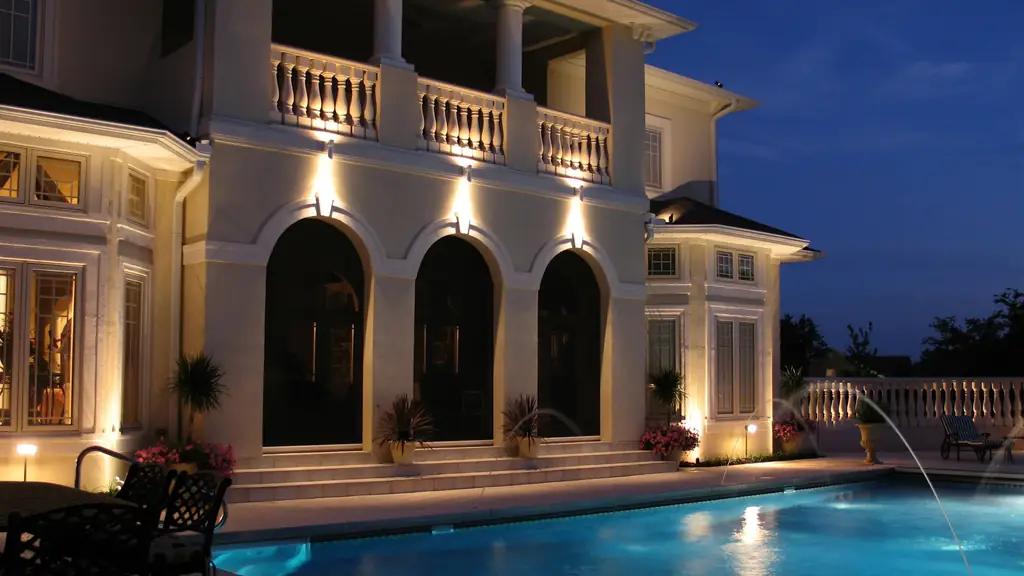
Newer properties with no canopy, where every source has to come off the house, the pergola or the pool house instead. Pool and deck lighting.
- Service calls across the county
Evansville generates a steady share of our roughly 110 monthly service visits. Repair and diagnosis.
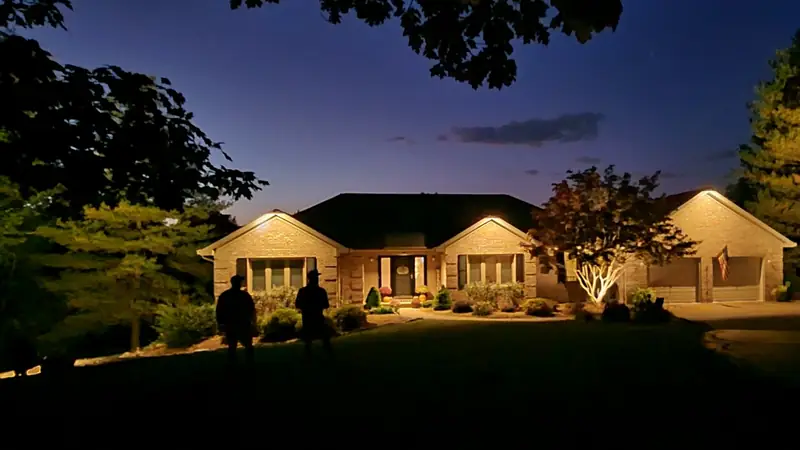
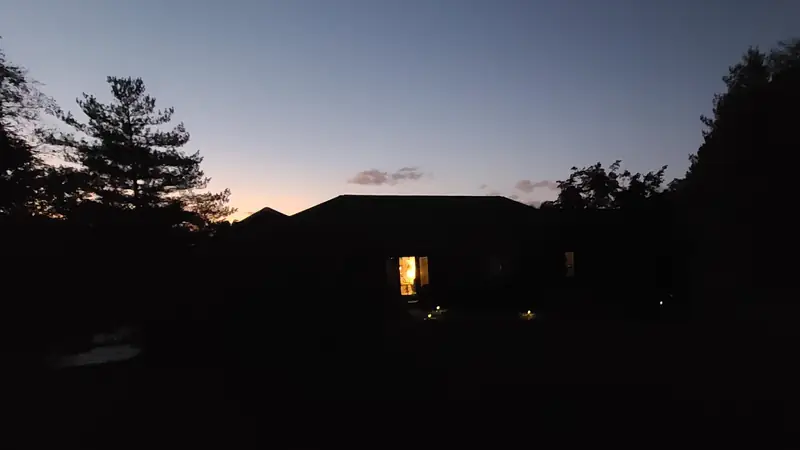
One house, before and after.
Gables washed from their peaks and the tree by the drive uplit. Drag the line to compare.
We are here constantly
Evansville and Newburgh together make up a large part of our working week.
The practical effect of that frequency is scheduling. Vanderburgh County is not a county we visit occasionally and have to build a special trip for. There is generally a crew or a service technician across the river most weeks, which means a repair call rarely waits long and a maintenance visit can be slotted against work already booked nearby.
It also means we know the housing stock rather than guessing at it. Twenty-eight years of crossing the Ohio for this city is a reasonable amount of time to learn which streets have what behind the facades.
Evansville questions
Yes, and we work to whatever the district requires.
Our normal masonry method is already reversible: cable goes into the mortar joint and is re-tuckpointed over, rather than through the brick. Where a property needs approval before work begins we will provide the drawing, which is generally what a commission wants to see anyway.
Yes, because we are usually coming anyway.
Evansville and Newburgh are on the schedule most weeks, so a single service call gets grouped with work already booked in the county rather than being treated as a special trip.
That is exactly the failure mode, and the fix is the angle rather than the fixture.
Light thrown straight at half-timbering flattens it into a graphic. Light crossing it from close to the wall lets every timber cast a shadow line, which is what makes it read as three-dimensional after dark.
Long low elevations are a real design problem and a satisfying one.
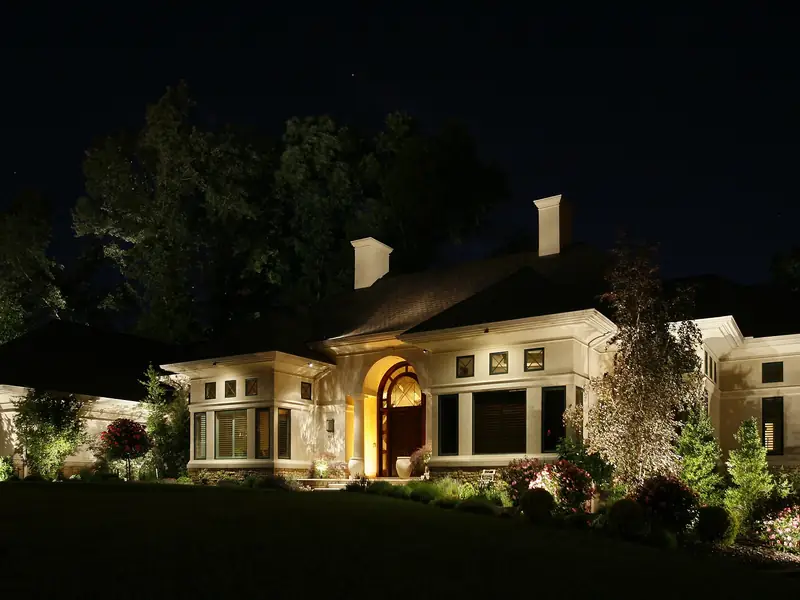
A ranch lit evenly end to end reads as a wall. The usual answer is to give the entry its own brighter zone, let the rest fall off, and use the planting and any mature trees to break the horizontal line so the house has depth instead of width.
Let's look at your property after dark
A designer comes out, walks the property with you and gives budget numbers by area. That visit carries no charge. If you want the drawing, we quote a design fee from there.
NiteLiters Inc. · 729 Cumberland St, Owensboro, KY 42303
Monday to Friday, 8:00am to 5:00pm